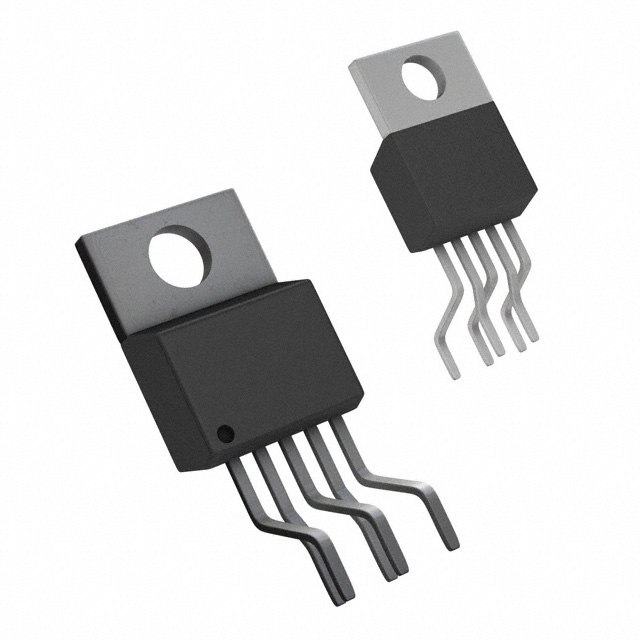
LM2596 Regulator Showdown: Adjustable vs. Fixed Output
The LM2596 is a workhorse regulator, but choosing between the adjustable (LM2596T-ADJ/NOPB) and fixed 5V (LM2596T-12) versions hinges on design flexibility versus simplicity. For applications needing precise voltage regulation beyond the fixed 5V, the adjustable version is the clear winner. However, for simple 5V power applications where fine-grained control isn’t required, the fixed output version offers a streamlined and cost-effective solution, sacrificing some design flexibility.
Spec Comparison Table
| Spec | LM2596T-ADJ/NOPB | LM2596T-12 | Notes |
|---|---|---|---|
| Output Voltage | Adjustable (external resistors) | 5V Fixed | The adjustable version provides flexibility for a wider range of applications, but requires external components and calibration. |
| Input Voltage Range | 4.5V – 40V | 4.5V – 40V | Identical input voltage range. |
| Output Voltage Range | 3V – 37V (typical) | 5V Fixed | Adjustable version allows for more versatile voltage requirements. |
| Output Current | 3A | 3A | Both parts offer the same maximum output current. |
| Switching Frequency | 150 kHz | 150 kHz | Same switching frequency. |
| Quiescent Current (typ) | 5 mA | 5 mA | Identical quiescent current. |
| Standby Quiescent Current (typ) | 200 µA | 200 µA | Same standby current. |
| Input Schottky Rectifier Current Rating | 5A | 5A | Identical current rating. |
| Input Schottky Rectifier Voltage Rating | 40V | 40V | Same voltage rating. |
| Inductor Value (typical) | 68uH | 68uH | Same inductor value. |
| Output Leakage Current (typ) | 25 µA | 25 µA | Identical leakage current. |
| Feedback Bias Current (typ) | 12 nA | 12 nA | Same feedback bias current. |
| On/Off Pin Input Current (typ) | 15 µA | 15 µA | Same on/off pin current. |
| Output Voltage to Ground (min) | -1.0V | -1.0V | Same minimum voltage. |
Design Trade-offs
The most significant trade-off is the adjustable output versus the fixed 5V. The adjustable version requires two external resistors to set the output voltage, introducing a small calibration step during prototyping and potential drift due to temperature or component tolerances. This flexibility, however, is invaluable when the application needs a voltage outside the standard 5V. The fixed version simplifies the design, eliminating the need for external resistors and calibration, but locks the output voltage to 5V.
Thermal considerations are similar for both parts, as they both dissipate heat based on input voltage, output current, and efficiency. However, the adjustable version’s output voltage can be programmed to minimize power dissipation in specific scenarios, potentially improving overall thermal performance.
Gate drive requirements are standard for both, typical of a simple PWM controller. Layout sensitivity is also similar, requiring careful attention to ground plane integrity and minimizing loop areas to prevent EMI. The adjustable version, due to the external resistor network, might be slightly more sensitive to resistor placement, but the difference is likely marginal.
Cost at volume is likely very close, with the fixed output version potentially having a slight edge due to the elimination of the external resistor network. However, the cost savings are unlikely to be significant.
Use-case Fit
Choose LM2596T-ADJ/NOPB when…
- Battery-powered devices requiring a non-standard voltage: A 3.3V rail for a microcontroller and peripherals, while maintaining a 12V input.
- Driving a chain of voltage regulators: Generating a 10V intermediate bus from a 24V input, simplifying downstream regulation.
- Precision voltage references: Creating a stable voltage for analog circuits requiring tighter voltage tolerances than 5V.
- Dynamically adjustable voltage rails: A system where the voltage needs to change based on load conditions or user settings.
- Powering an LCD backlight: Needing a 3.3V rail for the backlight driver, while maintaining a 12V input.
Choose LM2596T-12 when…
- Simple 5V power supply for a microcontroller: A straightforward 5V rail for a microcontroller and associated peripherals, where no voltage adjustment is needed.
- Driving a standard 5V peripheral: Powering a USB hub or other 5V device, where a fixed 5V output is sufficient.
- Cost-sensitive applications: A budget-constrained project where minimizing component count is a priority.
- Rapid prototyping: A quick and easy 5V power solution for initial testing and validation.
- Replacing an existing 8V/5V adapter: A drop-in replacement for a faulty 8V/5V adapter, where the 5V output is the only requirement.
Drop-in Compatibility
Pin compatibility is likely very high, as both parts have the same pinout and functionality. However, footprint compatibility is also likely, assuming the external resistor network for the adjustable version is accommodated on the board. Substituting one for the other requires careful consideration of the output voltage requirements. If substituting the adjustable version with the fixed version, the external resistor network must be removed.
Alternatives to Consider
- LM2596-5.0: Another fixed output version, but with a different package.
- TPS5430: A synchronous buck converter offering higher efficiency, but with increased complexity.
- LM317: A simpler adjustable regulator, but with lower efficiency and current capability.